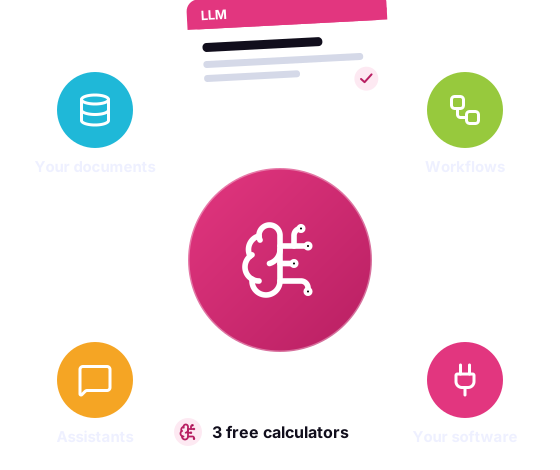
- An LLM agency designs, builds and runs software that uses large language models: chatbots, document Q&A (RAG), AI agents that automate workflows, and LLM features inside your existing systems.
- Most business problems are solved by good prompting plus RAG over your own documents. Fine-tuning is needed less often than people expect, and agents need the most care.
- Running costs are mainly per-token API charges. They are often small next to staff time, but they scale with volume and with how much text you send each time: estimate them before you build.
- Evaluation is the part to insist on: a written set of real test questions with expected answers, run before launch and after every change.
- If personal data is involved, UK GDPR applies in full and the ICO says most AI uses of personal data need a DPIA. The EU AI Act can also apply to UK firms serving EU users.
What does an LLM agency do?
An LLM agency is a specialist software and AI consultancy that builds applications on large language models (LLMs), the technology behind tools such as ChatGPT. It works out where an LLM can genuinely help your business, builds and tests the system on your data, connects it to your existing software, and keeps it accurate, secure and affordable after launch.
Find the right use cases
Separate the jobs an LLM does well (reading, summarising, drafting, classifying, answering from documents) from the ones it doesn't.
Connect your knowledge
Make your documents and data searchable by the model, with the same access rules your staff have.
Automate the workflow
Link the model to your CRM, inbox, ticketing or finance systems so work moves without copy and paste.
Prove it works
Build an evaluation set of real examples and measure accuracy before and after every change.
Keep it safe
Handle personal data lawfully, defend against prompt injection, log what happens and keep humans in control.
Run and improve it
Monitor quality, cost and speed in production, swap models as better or cheaper ones arrive, and fix what users report.
LLM agencies go by several names: LLM development agency, LLM consultancy, generative AI agency, AI agent development agency, or simply an AI development partner. The labels overlap. What matters is whether the firm can take an idea from a workshop to a tested, secure system your staff or customers actually use, and keep it working.
What an LLM agency is not: a reseller of one chatbot product, or a training provider. Off-the-shelf tools are fine for personal productivity; an agency is for when the work has to use your data, follow your rules or plug into your systems.
LLM agency services: what you can hire one to build
A full-service LLM development agency covers eight areas: LLM apps and chatbots, RAG over company documents, AI agents and workflow automation, LLM integration into existing software, fine-tuning and evaluation, AI strategy and use-case discovery, governance and compliance, and LLMOps (running and monitoring in production). Many projects use three or four of these together.
LLM apps and custom chatbots
Custom GPT-style assistants for customers or staff, on your website, in Teams or Slack, or inside your app. Built around your tone, your rules and what it must never say.
Typical deliverables: Chat interface, system prompts, guardrails, hand-off to a human
RAG over company documents
Retrieval-augmented generation: your documents are split, indexed and searched at question time, and the model answers from the passages it finds, with references.
Typical deliverables: Ingestion pipeline, vector or hybrid search, citations, permission-aware retrieval
AI agents and workflow automation
Models that call tools in defined steps: read an email, look up the customer, draft a reply, raise a ticket. Agents work best with narrow jobs and clear approval points.
Typical deliverables: Tool integrations, approval steps, audit log, retry and failure handling
LLM integration into existing software
Adding summarisation, extraction, search or drafting to software you already own, through APIs, without rebuilding it.
Typical deliverables: API integration, structured outputs, rate limiting, cost tracking
Fine-tuning and evaluation
Training a model further on your examples when prompting isn't consistent enough, and building the test sets that prove any change is an improvement.
Typical deliverables: Training data, fine-tuned model, evaluation reports
AI strategy and use-case discovery
Workshops and audits to find where LLMs will save time or improve service, ranked by value, risk and data readiness, with a business case.
Typical deliverables: Use-case shortlist, data audit, roadmap, ROI estimates
Governance and compliance readiness
UK GDPR and DPIAs, EU AI Act classification for systems used in the EU, acceptable-use policies and model risk records.
Typical deliverables: DPIA support, risk register, transparency notices, policies
LLMOps and monitoring
Running LLM systems in production: monitoring quality, cost and speed, version control for prompts, regression tests and model upgrades.
Typical deliverables: Dashboards, alerts, prompt versioning, monthly reports
RAG development, fine-tuning LLMs or AI agents: what's the difference?
RAG development changes what the model knows at the moment it answers, by retrieving your documents. Fine-tuning LLMs changes how the model behaves: its format, tone or labelling. AI agents change what the model can do, by letting it call tools. Most projects start with prompting, add RAG for knowledge, and add agent steps for actions. Not sure which you need? Use the selector below.
Which LLM approach do I need? Prompting, RAG, agents or fine-tuning
This selector recommends which LLM approach fits your project, prompting an off-the-shelf model, RAG, an AI agent, fine-tuning or a combination, from six questions about your data, actions, format, volume and sensitivity. For example, a staff assistant answering questions from HR policies needs RAG (retrieval-augmented generation) on top of a well-written prompt.
1. Where does the knowledge for good answers come from?Policies, manuals, contracts, product data, past tickets and so on.
2. Does that information change often, or must answers quote where they came from?For example, prices, stock, policies updated monthly, or answers that need a reference.
3. Does it need to take actions in other systems?Update a CRM, raise a ticket, book an appointment, query a database, send an email.
4. Do you need a very specific style, format or label that examples in a prompt don't reliably produce?For example, a house style across thousands of outputs, or a fixed set of categories.
5. How many requests a month?Volume changes whether a cheaper, specialised model pays off.
6. How sensitive is the data?Special category data includes health, ethnicity, religion, trade union membership and biometrics.
| Project | Recommended approach | Try it |
|---|---|---|
| Marketing copy helper for a small team | Prompting an off-the-shelf model | Load |
| Staff Q&A over HR policies and handbooks | RAG (retrieval-augmented generation) | Load |
| Customer service bot that can check orders and raise returns | Combination: RAG + AI agent / workflow automation | Load |
| Classifying 200,000 support tickets a month into fixed categories | Fine-tuning | Load |
| Assistant drafting letters from case files with health data | RAG (retrieval-augmented generation) | Load |
| Sales agent that researches leads and updates the CRM | AI agent / workflow automation | Load |
| Extracting product data from supplier sheets in a strict format, high volume | Fine-tuning | Load |
How the selector decides
- Everything starts with prompting an off-the-shelf model: clear instructions, examples, structured output and testing.
- Add RAG if answers depend on your own documents or data (question 1), or on information that changes or must be cited (question 2).
- Add an AI agent / workflow automation if it must take actions in other systems (question 3).
- Add fine-tuning only if you need a specific style, format or label that prompting doesn't reliably produce and volume is 50,000 requests a month or more (questions 4 and 5). At lower volume it suggests trying examples and structured output first.
- At high volume without fine-tuning, it suggests testing a smaller, cheaper model.
- Data sensitivity (question 6) doesn't change the approach, but adds data protection steps: a DPIA for personal data; for special category, financial or privileged data, also regional hosting or an open-weight model in your own cloud, and human review.
These rules are our own rule of thumb, written to match how we'd scope a project; they're not an industry standard. Your answers stay in your browser.
Share your answers: the link under the result reproduces it. Format: ?needs= then six letters in question order: 1 g/o (general/own data), 2 n/y, 3 n/y, 4 n/y, 5 l/h (volume low/high), 6 l/p/s (sensitivity). Example: https://thellmagency.co.uk/?needs=oynnlp recommends RAG (retrieval-augmented generation).
Typical LLM projects by sector
The best first LLM projects remove repetitive reading and writing: answering questions from documents, triaging emails and tickets, extracting data from forms, and drafting first versions for a person to check. The watch-outs depend on your sector's data and rules.
| Sector | Typical LLM projects | Watch-outs |
|---|---|---|
| Legal and professional services | Searching precedents and internal know-how, first-draft letters and clauses, summarising long documents, time-recording narratives. | Client confidentiality and privilege; every output a lawyer relies on needs human review. |
| Financial services and insurance | Complaint and email triage, extracting data from forms and statements, drafting customer letters, policy wording Q&A for staff. | Credit scoring that decides access to loans is high-risk under the EU AI Act; keep advice and decisions with qualified people. |
| Healthcare and care providers | Admin letters, summarising referrals for clinicians to check, staff Q&A over policies, rota and booking support. | Health data is special category data: DPIA, strict access control, no automated clinical decisions. |
| Retail and e-commerce | Product descriptions at scale, customer service chat that checks orders, review summaries, better site search. | Customers must know they're talking to a machine; brand tone and pricing accuracy need testing. |
| Manufacturing and engineering | Q&A over technical manuals and standards, maintenance logs, quality and incident report summaries, quote preparation. | Drawings and tables in PDFs need careful handling; safety-critical answers need sign-off. |
| Recruitment and HR | Job adverts, interview notes, HR policy assistants for staff. | CV sorting and worker management are high-risk uses under the EU AI Act; avoid automated decisions about people. |
| Public sector and charities | Casework summaries, enquiry handling, grant and bid writing support, searching large document stores. | Follow the UK Government's AI Playbook; transparency and equality duties apply. |
| Property, construction and facilities | Tender and specification review, health and safety document Q&A, lease summaries, maintenance request triage. | Large scanned documents; make sure the source page is always shown. |
Across every sector, the strongest candidates share three traits: lots of volume, a clear definition of a good answer, and a person who can check the output when it matters.
How an LLM project runs: from discovery to support
A well-run LLM project moves through six stages: discovery, prototype, build, evaluate, deploy and support. The prototype and evaluation stages are what separate projects that work from expensive demos: you decide whether to continue on evidence from your own data.
The six stages of an LLM project
- DiscoveryAgree the business goal, the people who'll use it, the data available, the risks and how success will be measured.Typically 1 to 2 weeks
- PrototypeA quick working version on your real data, tested against a first evaluation set, so you can decide go or no-go with evidence.Typically 2 to 4 weeks
- BuildProduction engineering: integrations, user interface, access control, logging, error handling, cost controls.Typically 4 to 12 weeks
- EvaluateRun the full test set, red-team for prompt injection and misuse, check accuracy, tone, speed and cost against the targets.Typically 1 to 3 weeks, then ongoing
- DeployLaunch to a pilot group first, train users, publish transparency information, then widen access.Typically 1 to 2 weeks
- SupportMonitor quality and cost, fix issues, update documents, re-test after every model or prompt change.Typically ongoing
Timings are our typical ranges for a single, focused use case. Evaluation never really stops: every time you change a prompt, a document set or the model, re-run the tests.
How much does an LLM project cost in the UK?
A typical UK LLM project costs from a few thousand pounds for a discovery workshop to tens of thousands for a production RAG assistant or AI agent. On our guide below, a prototype is £6,500 to £19,000 and a production document assistant £19,500 to £57,000, plus running costs. These are our planning ranges (days of work × a stated day rate), not market statistics.
| Project type | Effort | Our guide cost | Typical timeline | What you get |
|---|---|---|---|---|
| Discovery and use-case workshop | 3 to 6 days | £1,950 to £5,700 | 1 to 2 weeks | Use cases ranked by value and risk, data audit, recommended approach, rough costs. |
| Proof of concept / prototype | 10 to 20 days | £6,500 to £19,000 | 2 to 4 weeks | A working prototype on your real data, an evaluation set and a go/no-go report. |
| LLM integration into existing software or APIs | 15 to 40 days | £9,750 to £38,000 | 3 to 8 weeks | LLM features inside your product or systems, with error handling, logging and cost controls. |
| Production chatbot or RAG assistant over company documents | 30 to 60 days | £19,500 to £57,000 | 6 to 12 weeks | Document ingestion, search, chat interface, access controls, evaluation and monitoring. |
| Fine-tuning and evaluation project | 25 to 50 days | £16,250 to £47,500 | 5 to 10 weeks | Training data preparation, fine-tuned model, side-by-side evaluation. Training compute is extra. |
| AI agent / workflow automation with integrations | 40 to 80 days | £26,000 to £76,000 | 8 to 16 weeks | Multi-step automation calling your systems, approval steps, audit logs, failure handling. |
| Ongoing support and LLMOps | 2 to 6 days a month | £1,300 to £5,700 a month | Ongoing | Monitoring, fixes, document updates, re-testing after model changes. |
How we got these figures: the effort in days is our estimate for a single, focused use case with reasonably organised data. The £650 to £950 day rate is our planning assumption for a blended UK senior team (engineer, data specialist, project lead); it is not a published market rate, and agency and freelance rates vary widely. Running costs (API tokens, hosting) are extra: use the API cost estimator below.
Midpoint of our guide cost range, by project type
What drives the cost of an LLM project
State of your data
Clean, digital, well-organised documents are quick to use. Scanned PDFs, spreadsheets with merged cells and scattered SharePoint sites take time.
Number of integrations
Each system the LLM reads from or writes to (CRM, ERP, ticketing, email) adds build and testing time.
Accuracy bar
An internal drafting helper can tolerate rough edges; a customer-facing answer about prices or policy needs far more evaluation.
Risk and compliance
Personal or special category data, regulated advice or EU users mean DPIAs, extra controls and documentation.
Volume and speed
High volumes or strict response times push you to caching, smaller models and careful prompt design.
Who runs it afterwards
Handing over to your team needs documentation and training; agency-run support is a monthly cost.
What to get in writing before you sign
- Exactly what's in scope: users, documents, integrations, languages, channels.
- How accuracy will be measured, with the evaluation set and the target agreed before build.
- Running costs: a token cost estimate at your expected volume, plus hosting and support.
- Who owns the code, prompts, evaluation sets and any fine-tuned model.
- Which model provider and region, and whether you can switch provider later.
- What support looks like after launch, and how model upgrades are handled.
LLM automation ROI and payback calculator
This LLM automation ROI calculator works out how many staff hours an LLM system saves each month, the net saving after running costs, and how quickly it pays back its build cost. For example, 400 tasks a month taking 12 minutes each, with 60% automated at £25 an hour, saves 48 hours and £800.0 a month net, paying back an £18,000 build in 22.5 months.
| Scenario (tasks/month × minutes, % automated, £/hour, build £, running £/month) | Hours saved/month | Net saving/month | Payback | ROI 36 months | Try it |
|---|---|---|---|---|---|
| Sorting and drafting replies to customer emails 2,000 × 4 min, 70%, £22/h, £15,000, £300/month | 93.3 | £1,753 | 8.6 months | 321% | Load |
| Internal knowledge assistant (staff questions about policies and procedures) 1,200 × 10 min, 50%, £30/h, £25,000, £500/month | 100 | £2,500 | 10 months | 260% | Load |
| Pulling data out of invoices and forms 3,000 × 3 min, 80%, £20/h, £20,000, £400/month | 120 | £2,000 | 10 months | 260% | Load |
| First drafts of proposals or reports 60 × 120 min, 40%, £45/h, £18,000, £150/month | 48 | £2,010 | 9 months | 302% | Load |
| Website chatbot answering routine customer questions 4,000 × 6 min, 30%, £20/h, £30,000, £800/month | 120 | £1,600 | 18.8 months | 92% | Load |
| Our worked example (used in the calculator defaults) 400 × 12 min, 60%, £25/h, £18,000, £400/month | 48 | £800 | 22.5 months | 60% | Load |
How the ROI is calculated
- Hours saved a month = tasks per month × minutes per task ÷ 60 × % automatable ÷ 100.
- Gross saving a month = hours saved × staff cost per hour.
- Net saving a month = gross saving − monthly running cost. Annual net saving = net × 12.
- Payback (months) = build cost ÷ net monthly saving (only if the net saving is above zero).
- ROI over 12 or 36 months = (net monthly saving × 12 or 36 − build cost) ÷ build cost × 100.
- Hours are rounded to one decimal place, pounds and percentages to the nearest whole number, payback to one decimal place (halves round up).
Inputs and assumptions: every figure is yours; the defaults are just a worked example. "% automatable" is the share of the time the system takes over after allowing for staff checking its output, so be conservative. Staff cost per hour should include employer National Insurance, pension and overheads, not just salary. Running cost covers API tokens (see the estimator below), hosting and support.
Not included: time spent by your team during the project, training, change management, the value of faster responses or fewer errors, and tax. Saved hours are only a cash saving if they are redeployed to other valuable work or reduce overtime, temporary staff or hiring.
Share a result: parameters tasks, mins, auto (%), rate (£/hour), build (£), run (£/month). Example: https://thellmagency.co.uk/?tasks=400&mins=12&auto=60&rate=25&build=18000&run=400 gives 48 hours and £800 a month net, payback 22.5 months, 36-month ROI 60%.
LLM API cost estimator: what will it cost to run?
This LLM API cost estimator works out the monthly and annual cost of calling a large language model, in pounds, from your request volume, token counts and the provider's price per million tokens. For example, 20,000 requests a month with 1,500 input and 400 output tokens each, at $1.00 and $5.00 per million tokens, costs about £53.20 a month (£638.40 a year).
Optional: fill in an official list priceStandard rates per 1 million tokens, last checked 16 November 2026. Prices change: check the source before you rely on them.
| Scenario | Requests/month | Tokens in / out | $ per 1M in / out | £ a month | £ a year | Try it |
|---|---|---|---|---|---|---|
| Small FAQ chatbot, low-cost model | 5,000 | 1,000 / 300 | $0.10 / $0.50 | £0.95 | £11.40 | Load |
| Small FAQ chatbot, mid-priced model | 5,000 | 1,000 / 300 | $1.00 / $5.00 | £9.50 | £114.00 | Load |
| Document Q&A (RAG) assistant, mid-priced model | 20,000 | 1,500 / 400 | $1.00 / $5.00 | £53.20 | £638.40 | Load |
| Document Q&A with long retrieved context, higher-priced model | 20,000 | 6,000 / 600 | $2.00 / $10.00 | £273.60 | £3,283.20 | Load |
| Processing 100,000 documents a month, low-cost model | 100,000 | 3,000 / 500 | $0.10 / $0.50 | £41.80 | £501.60 | Load |
| Multi-step agent runs (several model calls each), higher-priced model | 10,000 | 25,000 / 2,000 | $2.00 / $10.00 | £532.00 | £6,384.00 | Load |
| Model | Input | Output | Rate used | Source |
|---|---|---|---|---|
| OpenAI gpt-6.1-sol | $2.00 | $10.00 | standard, short context (up to 272K input tokens) | official price list |
| OpenAI gpt-6.1-terra | $1.00 | $5.00 | standard, short context (up to 272K input tokens) | official price list |
| OpenAI gpt-6-luna | $0.10 | $0.50 | standard, short context (up to 272K input tokens) | official price list |
| Anthropic Claude Opus 5.5 | $4.00 | $20.00 | base input and output tokens | official price list |
| Anthropic Claude Sonnet 5.5 | $2.00 | $10.00 | base input and output tokens | official price list |
| Anthropic Claude Haiku 5.5 | $0.10 | $0.50 | prompts up to 100,000 tokens | official price list |
Presets are a sample of current models from two providers whose official price pages we could read on the day we checked; their inclusion isn't a recommendation. Other providers and open-weight models may suit you better: type any price into the boxes.
How the API cost is calculated
- Cost per request (US$) = (input tokens × input price + output tokens × output price) ÷ 1,000,000.
- Monthly cost (US$) = cost per request × requests per month.
- Monthly cost (£) = monthly US$ × exchange rate. The default rate, £0.76 per $1, is from the ECB euro reference rates for 16 November 2026 (€1 = $1.1014 = £0.8345, so $1 ≈ £0.7577), rounded to £0.76. Change it to today's rate if you like.
- Annual cost = monthly £ × 12. Cost per 1,000 requests = monthly £ ÷ requests × 1,000. Pounds are rounded to the penny.
Assumptions and exclusions: standard (not batch) rates with no cached-input discount; prices before VAT; no allowance for long-context surcharges, regional processing uplifts, failed or retried requests, embeddings for RAG, fine-tuning, hosting or support. A rough guide to tokens: in English, 1,000 tokens is roughly 750 words (a common rule of thumb; it varies by model and language). For RAG, input tokens include the retrieved passages, and for chat they include the conversation so far, which is why input is usually much larger than output.
What the official price lists show
- Both official API price lists we checked charge per million tokens, with output tokens priced five times input tokens on every model we used as a preset.
- Both offer cheaper rates for cached input, and the OpenAI list shows batch processing at half the standard rate (OpenAI pricing).
- Choosing a specific processing region costs more: OpenAI adds 10% for data-residency endpoints on newer models, and Anthropic charges 1.1 times standard for US-only inference (OpenAI, Anthropic).
- Some models charge more for very long prompts (for example above 272,000 or 100,000 input tokens), so long contexts can cost more than a simple multiplication suggests.
Share an estimate: parameters req, tin, tout, pin, pout (US$ per 1M tokens), fx (£ per $1). Example: https://thellmagency.co.uk/?req=20000&tin=1500&tout=400&pin=1&pout=5&fx=0.76 = £53.20 a month.
Open or closed models: which LLM should you use?
Choose between closed models, used through a provider's API or a major cloud platform, and open-weight models you can host yourself. Closed APIs are quickest to start and need no infrastructure; open-weight models give more control over where data goes and can be cheaper at very high volume. A good LLM agency stays model-agnostic and picks per task using your evaluation set.
| Aspect | Closed model via API or cloud platform | Open-weight model, self-hosted |
|---|---|---|
| How you use it | Call the provider's API, or the same models through a major cloud platform's AI service | Download the weights and run them on your own servers or cloud account |
| Data handling | Data goes to the provider (check its business terms on retention and training, and the processing region) | Data stays in infrastructure you control |
| Cost model | Pay per token; no fixed infrastructure cost | Pay for servers or GPUs whether busy or idle; can be cheaper at sustained high volume |
| Customisation | Prompting, RAG, and fine-tuning where the provider offers it | Full fine-tuning and control over the model version |
| Upgrades | Provider retires old versions on its own timetable: plan re-testing | You choose when to upgrade, but you also maintain it |
| Best for | Most business projects, prototypes, variable volumes | Strict data-location needs, very high steady volumes, offline or specialist use |
How to choose a model in practice
- Write the evaluation set first: 50 to 200 real examples with what a good answer looks like.
- Shortlist two or three models across price tiers, including a small, cheap one.
- Run the set on each; compare accuracy, speed and cost per 1,000 requests.
- Pick the cheapest model that meets your bar, and keep the code provider-neutral so you can switch.
- Re-run the set when providers release or retire models.
Public benchmark leaderboards are a starting point, but they rarely test your documents, your format or your customers' questions.
Data security and compliance: UK GDPR, the ICO and the EU AI Act
If your LLM system handles personal data, UK GDPR applies in full: you need a lawful basis, transparency, security and, in most cases, a data protection impact assessment (DPIA). The EU AI Act adds duties if you offer AI systems in the EU, starting with chatbot transparency from August 2026. The NCSC and OWASP publish the security practices a good agency should follow.
UK GDPR and the ICO
The ICO's guidance on AI and data protection covers lawfulness, fairness, transparency, accuracy and security. It says that "in the vast majority of cases" using AI will involve processing likely to result in a high risk, which triggers the legal requirement for a DPIA (ICO). For decisions that affect people, see the ICO's Explaining decisions made with AI.
Data (Use and Access) Act 2025
The Data (Use and Access) Act 2025 amends, but doesn't replace, UK GDPR, the DPA 2018 and PECR, with changes phased in between June 2025 and June 2026. It widens the lawful bases available for significant automated decisions, with safeguards still required, and not for special category data (ICO summary).
Where data goes
If a model provider processes data outside the UK, the international transfer rules apply. Ask where prompts and outputs are processed and stored, for how long, and whether they're used for training under the business terms you're on.
EU AI Act
The AI Act entered into force on 1 August 2024. Prohibited practices applied from February 2025, rules for general-purpose AI model providers from August 2025, and transparency rules (such as telling people they're talking to a chatbot) from August 2026. Rules for high-risk uses in areas such as employment, education and access to essential services apply from 2 December 2027 (European Commission). It can apply to UK businesses that offer AI systems in the EU.
Security
The NCSC's Guidelines for secure AI system development cover secure design, development, deployment and operation. OWASP lists prompt injection as the top risk for LLM applications: text in a document or email can try to give the model new instructions, so agents should only have the permissions they need.
Public sector
Public bodies should follow the AI Playbook for the UK Government, which sets out principles for using AI safely and responsibly.
A practical compliance checklist for an LLM project
- Map what personal data goes into prompts, documents and logs, and minimise it.
- Agree the lawful basis and do a DPIA before building with personal data.
- Check the provider's business terms: data retention, training use, sub-processors and processing region.
- Tell users they're dealing with AI, and explain how to reach a person.
- Restrict retrieval to what each user may see; log prompts and outputs securely, for a defined period.
- Give agents the minimum permissions, and require human approval for consequential actions.
- Test for prompt injection and harmful outputs before launch and after changes.
- If you serve EU users, check whether your use is high-risk under the AI Act.
This is general information, not legal advice. For high-risk or regulated uses, take advice from a qualified data protection or legal professional.
How to choose an LLM agency: a 10-point checklist
Choose an LLM agency that starts with your business problem, not a favourite model; shows you how it will measure accuracy before it builds; is open about running costs; understands UK GDPR; and lets you own the code, prompts and data. Ask to see working demos, talk to the people who'll actually build it, and start with a paid discovery or prototype, not a big contract.
- Problem firstThey ask about your process, users and goal before talking about models.
- Evaluation planThey'll build a test set from your real examples and agree an accuracy target before the main build.
- Model-agnosticThey can explain why a given model suits your task, and how you'd switch provider.
- Cost transparencyThey estimate token and hosting costs at your volume, not just the build fee.
- Data protectionThey raise DPIAs, data locations and access control without being asked.
- SecurityThey can explain how they defend against prompt injection and limit what agents can do.
- Engineering depthIntegrations, testing, logging and monitoring, not just a prompt in a nice interface.
- OwnershipYou own the code, prompts, evaluation sets and any fine-tuned model.
- Staged contractDiscovery and prototype first, with a go/no-go point before the larger spend.
- Support planClear monthly support, response times and how model upgrades are re-tested.
Run a short, paid discovery or prototype with your preferred agency before committing to a full build. You'll learn more about how they work in three weeks than from any proposal.
Questions to ask an LLM agency before you sign
Ask how they'll measure accuracy, what it will cost to run, where your data goes, how they handle prompt injection and wrong answers, and who owns the work. Good answers are specific, refer to your data and admit what can't be promised.
- How will we know it's accurate enough?Look for a specific evaluation set, a measurable target and a plan to re-run it after every change.
- What will it cost to run each month at our volume?They should show the token maths, hosting and support, and how costs can be reduced.
- Which model will you use, and why?A good answer compares options for your task and keeps the choice reversible.
- Where will our data be processed and stored?Expect provider, region, retention period and whether data can be used for training.
- What happens when the model gets it wrong?Human review points, confidence thresholds, easy feedback and fallbacks to a person.
- How do you defend against prompt injection?Least-privilege tools, separating instructions from content, approval steps for risky actions, testing.
- Who will actually do the work?Meet the engineers, not just the sales team, and ask about similar projects they've built.
- Do we own everything you build?Code, prompts, evaluation sets, documentation, fine-tuned weights.
- What happens when a better or cheaper model comes out?They should re-run the evaluation set and switch only if it's better on your tests.
- Can we start small?A paid discovery or prototype with a clear go/no-go decision is a good sign.
Red flags when hiring an LLM agency
Be wary of an agency that promises no mistakes, has no evaluation plan, only demos on its own tidy data, recommends fine-tuning by default, won't estimate running costs, or gives agents broad permissions without approval steps.
- Promises of "no hallucinations" or 100% accuracyEvery LLM system makes mistakes; the honest answer is how errors are measured, reduced and caught.
- No evaluation planIf they can't say how accuracy will be tested before launch, they can't prove it works.
- A demo on their data, never yoursPolished demos on tidy sample data say little about your messy documents.
- Fine-tuning as the default answerMost knowledge problems are better solved with RAG; fine-tuning is for format and behaviour.
- Silence on running costsToken costs scale with use; you need an estimate before you commit.
- Locked in to one provider or platformYour prompts, data and code should move with you.
- Agents with broad permissionsAn agent that can send emails or change records without limits or approval is a security risk.
- No mention of UK GDPR or DPIAsIf personal data is involved, data protection is part of the build, not an afterthought.
- Big fixed contract up frontWithout a discovery or prototype stage you're paying for assumptions.
LLM agency vs freelancer vs in-house: should you hire LLM developers?
Hire an LLM agency when you need a working system within months and don't yet need permanent staff; hire a freelance LLM developer for a well-defined, smaller piece of work; build an in-house team when LLMs are core to your product and you have steady work for years. Many businesses start with an agency and hire in-house once the value is proven.
| Aspect | LLM agency | Freelance developer | In-house team |
|---|---|---|---|
| Time to start | Usually within weeks | Often quickest for a small job | Months to recruit |
| Range of skills | Strategy, data, engineering, design, security, compliance | Usually one person's skills | Whatever you hire; hard to cover everything |
| Cost structure | Project fee or day rate, plus optional support | Day rate, usually lower | Salaries, on-costs and tools, every month |
| Continuity | Team cover for holidays and staff changes | Depends on one person's availability | Strong if you retain people |
| Knowledge of your business | Builds up during the project | Builds up during the project | Deepest over time |
| Management effort for you | Lower: the agency runs the project | Higher: you manage scope and quality | Highest: you lead the team |
| Best for | First production systems, multi-skill projects | Prototypes, single integrations | LLMs as a core, long-term capability |
The LLM agency vs in-house question is rarely either/or. A common, sensible path: an agency runs discovery and the first production system, documents everything and trains your team; you then hire one or two LLM developers to own it, with the agency on call for bigger changes.
LLM glossary: the terms in plain English
The words you'll meet in LLM agency proposals, explained without jargon.
- Large language model (LLM)
- A model trained on large amounts of text that predicts and generates text. It powers chatbots, summarisation, drafting and extraction.
- Token
- The unit LLMs read and write, often part of a word. API prices are per million tokens, counted separately for input and output.
- Context window
- How much text a model can take in one request, including instructions, retrieved documents and chat history.
- Prompt
- The instructions and examples sent to the model. Prompt design is the cheapest way to change behaviour.
- RAG
- Retrieval-augmented generation: finding relevant passages in your documents and giving them to the model so it answers from them.
- Embedding
- A list of numbers representing the meaning of a piece of text, used to find passages with similar meaning.
- Vector database
- A store of embeddings that can be searched by meaning. Often combined with keyword search (hybrid search).
- Fine-tuning
- Further training a model on your own examples to change its style, format or behaviour.
- Open-weight model
- A model whose trained weights are published, so you can run it on your own infrastructure under its licence.
- AI agent
- A system where the model decides which tools to call, in steps, to complete a task, such as looking up a record and then updating it.
- Tool calling
- The model returning a structured request to run a function or API, which your software then executes.
- Hallucination
- A fluent but false or unsupported answer. Reduced by RAG, clear instructions, citations and evaluation, but never zero.
- Evaluation set (evals)
- A collection of real test inputs with expected outputs or scoring rules, run to measure quality before and after changes.
- Guardrails
- Checks on inputs and outputs that block unsafe, off-topic or badly formatted responses.
- Prompt injection
- Text hidden in user input, documents or web pages that tries to override the system's instructions.
- LLMOps
- Running LLM systems in production: monitoring, versioning prompts and models, regression testing and cost control.
- DPIA
- Data protection impact assessment: the UK GDPR process for identifying and reducing risks to people's data.
LLM agency FAQs
Short answers to the questions people ask most when they're looking to hire an LLM agency in the UK.
What is an LLM agency?
A specialist agency that designs, builds and supports software using large language models, such as custom chatbots, RAG assistants over company documents, AI agents and LLM features in existing systems.
What's the difference between an LLM agency and a generative AI agency?
Very little in practice. Generative AI agency is the broader term and can include image, audio and video work; an LLM agency focuses on text and language: chat, documents, data extraction and automation.
How much does an LLM project cost in the UK?
On our guide, a discovery workshop is about £1,950 to £5,700, a prototype £6,500 to £19,000 and a production RAG assistant £19,500 to £57,000, plus monthly running costs. Our ranges are days of work multiplied by a £650 to £950 day-rate planning assumption; real quotes vary with your data and integrations.
How long does it take to build an LLM application?
A prototype on your own data typically takes 2 to 4 weeks. A production chatbot or RAG assistant is typically 6 to 12 weeks, and an AI agent with several integrations 8 to 16 weeks.
What does it cost to run an LLM each month?
Mostly per-token API charges plus hosting and support. Use our API cost estimator: for example, 20,000 requests a month with 1,500 input and 400 output tokens at $1 and $5 per million tokens is about £53.20 a month at our stated exchange rate.
Do we need RAG or fine-tuning?
Use RAG when answers must come from your own or changing documents; use fine-tuning when you need a consistent style, format or label that prompting can't reliably produce. Many projects need RAG and never need fine-tuning.
What is an AI agent development agency?
An agency that builds AI agents: systems where a model calls tools step by step, such as reading an email, checking a customer record and drafting a reply. Good agent work includes permissions, approval steps and audit logs.
Can an LLM use our company documents securely?
Yes, with RAG built so each user only retrieves documents they're allowed to see, data processed in an agreed region under business terms, and logging. Personal data still needs a lawful basis and usually a DPIA.
Will our data be used to train the provider's model?
It depends on the provider and the terms you're on. Check the business or API terms for training use and retention before sending any personal or confidential data, and choose settings and regions to match.
Is ChatGPT enough, or do we need a custom GPT or chatbot?
Off-the-shelf tools are fine for individual staff productivity. You need custom chatbot development when it must answer from your data, follow your rules, connect to your systems, or face customers under your brand.
Should we hire LLM developers or use an agency?
Use an agency for a first production system or a project needing several skills; hire LLM developers in-house when LLMs become a core, long-term part of your product.
Which LLM is best for business?
There is no single best model. Compare two or three on your own evaluation set for accuracy, speed and cost, and keep the choice reversible as models change.
Does the EU AI Act apply to UK businesses?
It can, if you offer AI systems in the EU or their output is used there. Chatbot transparency rules apply from August 2026, and high-risk uses such as CV sorting from 2 December 2027.
How do you stop an LLM making things up?
Ground answers in your documents with RAG and citations, instruct it to say when it doesn't know, test with an evaluation set, and keep human review where mistakes matter. Errors can be reduced, not eliminated.
What should be in an LLM agency proposal?
Scope, evaluation method and accuracy target, running-cost estimate, model and data location, security approach, ownership of code and prompts, support terms and a staged plan with a go/no-go point.
Is an LLM consultancy the same as an LLM development agency?
An LLM consultancy UK firms hire may only advise on strategy and governance; an LLM development agency also builds and runs the system. Many do both: check whether the proposal includes engineering.
Book a free LLM project scoping call
Sources
Regulatory facts, prices and the exchange rate on this page come from these official sources, read on 16 November 2026. Cost ranges, timelines and the selector rules are our own guide and are labelled as such.
- ICO: Guidance on AI and data protection
- ICO: What are the accountability and governance implications of AI?
- ICO: Data protection impact assessments (DPIAs)
- ICO and The Alan Turing Institute: Explaining decisions made with AI
- ICO: International transfers
- ICO: The Data (Use and Access) Act 2025: what does it mean for organisations?
- legislation.gov.uk: Data (Use and Access) Act 2025
- European Commission: AI Act (regulatory framework for AI)
- EUR-Lex: Regulation (EU) 2024/1689 (the AI Act)
- NCSC: Guidelines for secure AI system development
- OWASP Gen AI Security Project: LLM01:2025 Prompt Injection
- GOV.UK: AI Playbook for the UK Government
- OpenAI API pricing (official list prices)
- Anthropic Claude API pricing (official list prices)
- European Central Bank: euro foreign exchange reference rates